Kelp and eelgrass meadows are nearshore habitats that provide physical complexity (aka places to lay eggs and hide from predators) in temperate marine waters. They’re also important for their roles as primary producers (fueling the food chain from the bottom up), producing the oxygen that fish (and humans!) breathe (through the magic of photosynthesis), and aid in carbon storage (by producing biomass that stays put). For these reasons, they are critical habitats that are protected by laws.
This post describes the governments, agencies, jurisdiction, and policies that manage critical marine vegetation ✨🌊🌿✨(kelp and eelgrass) habitat in the Puget Sound. The aim is to highlight the players (who), their roles (what), and their management tools (how) for protecting and restoring marine vegetation.
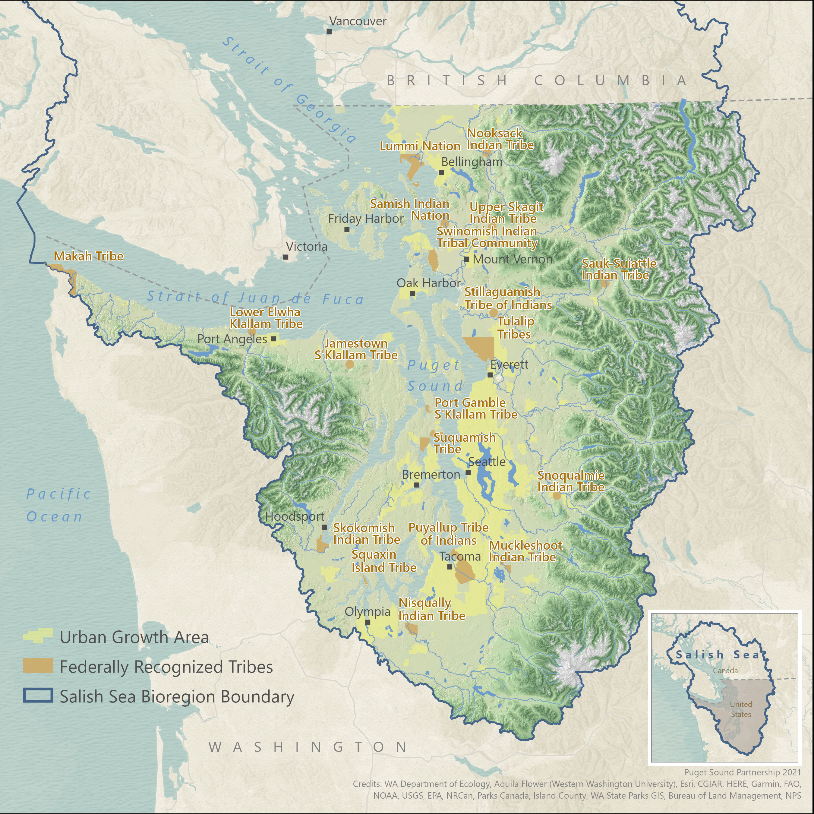
The Puget Sound encompasses the southern reaches of the Salish Sea. The Puget Sound is a fjord-formed estuary, a place where freshwater from rivers mixes with saltwater from the ocean.
1 Sovereign Tribal Governments
Prior to European contact, tribes governed their own affairs, and continue to do so today. Tribes have a sovereign right to govern their members and manage their lands and resources.
The United States recognized tribes as sovereign nations and the rightful owners of the land through the signing of treaties that carry the weight of the U.S. Constitution. Tribal sovereignty is further recognized with the government-to-government relationship that the tribes have with the federal government. - Northwest Indian Fisheries Commission
For more information, explore the Northwest Indian Fisheries Commission webpages and read Understanding Tribal Treaty Rights in Western Washington.
From 1889 to 1971 individuals could purchase tidelands or shorelands from the State of Washington. Because of this, 70% of tidelands (submerged lands from Ordinary High Tide to Extreme Low Tide) in Washington are privately owned.
Because of Tribal treaties (signed prior, from 1854 - 1856) , tribal members can come onto private property to harvest shellfish, finfish, and kelp!
Fifteen western Washington tribes can access private tidelands for harvest: Jamestown S’Klallam, Lower Elwha Klallam, Lummi, Makah, Muckleshoot, Nisqually, Nooksack, Port Gamble S’Klallam, Puyallup, Skokomish, Squaxin Island, Suquamish, Swinomish, Tulalip, and Upper Skagit.
Each tribe has a “usual and accustomed” harvest area (U&A) that reflects the historical region in which finfish, shellfish, and other natural resources (like marine vegetation!✨🌊🌿✨) were collected. All tidelands in Puget Sound are within the usual and accustomed harvest areas of one or more tribe.
2 National Estuary Program
Congress created the National Estuary Program (NEP) in 1987 under section 320 of the Clean Water Act (CWA) and initiated Puget Sound as an Estuary of National Significance in 1988. Puget Sound is the 2nd largest estuary in the U.S (after Chesapeake Bay).
player (who): The National Estuary Program
roles (what): Provides funding💰, guidance, and technical assistance to the local protection and restoration of Puget Sound. They are the administrative gatekeepers of the EPA grant money, a budget that is designated via Congress and the Clean Water Act.
tools (how):
The Environmental Protection Agency (EPA) hosts the NEP and the Puget Sound Recovery National Program Office. The NEP is a non-regulatory program, that abides by section 320 of the Clean Water Act, which mandates a Comprehensive Conservation Management Plan (CCMP) be developed and implemented to protect and restore water quality and living resources of Puget Sound.
2.1 Puget Sound Recovery National Program Office
Congress established the Puget Sound Recovery National Program Office within the Environmental Protection Agency (EPA) in 2016 to coordinate funding 💰 and grants from the EPA’s NEP. This office awards the grants that are distributed through Puget Sound Partnership to each Strategic Implementation Lead (SIL). A total of $120 million divided across the three SILs (1. Habitat, 2. Shellfish, 3. Stormwater) is provided incrementally over a five-year period. Meaning if distributed equally, each SIL would have an annual budget of $8 million.
3 Puget Sound Partnership
In order to protect and restore, we need a plan that everyone1 who has regulatory authorities over activities in the Puget Sound can agree to work towards together. That’s where Puget Sound Partnership comes in.
1 In Puget Sound ‘everyone’ involved are called the Management Conference: “Collectively, the governments, organizations, businesses, and individuals engaged in Puget Sound recovery are called the Management Conference; which uses a collaborative, consensus-building approach to develop and implement the Puget Sound Action Agenda.” Puget Sound Partnership develops the action agenda with 19 federally recognized Tribal governments, 10 Local Integrating Organizations, 4 boards, the public, and subject-matter experts.
The Washington State Legislature created the Puget Sound Partnership in 2007 as a state agency assigned to coordinating and leading restoration and protection efforts in Puget Sound. Read more about Puget Sound Partnership’s role here.
player: Puget Sound Partnership
roles: Getting everyone together to cooperate and coordinate Puget Sound recovery and protection efforts. Local (aka State) coordinating agency for the EPA’s NEP funding💰for Puget Sound. The primary goal of the Puget Sound Partnership is to coordinate a recovery and protection plan for Puget Sound, and they do that primarily through the Puget Sound Action Agenda (basically a prioritized goals list).
Puget Sound Partnership also manages:
2 4 Puget Sound Acquisition and Restoration Fund (PSAR)
Puget Sound Partnership and Washington State Recreation and Conservation Office co-administers the Puget Sound Acquisition and Restoration (PSAR) fund, which supports projects that recover salmon🐟and protect and recover salmon habitat in Puget Sound.
PSAR investments have helped restore and protect over 3,300 acres of estuary habitat, more than 150 miles for fish passage, and over 14,000 acres of watershed habitat. These projects support multiple benefits in addition to Puget Sound salmon, including climate resilience and flood protection, recreation, and tribal treaty rights.
This relates to management of marine vegetation ✨🌊🌿✨ because the habitat restoration and protection that PSAR does often feature eelgrass restoration
3 5 Puget Sound Ecosystem Monitoring Program (PSEMP)
The Puget Sound Partnership financially supports the PSEMP, which is a collaborative network of subject matter experts from many monitoring organizations throughout the region. Together, they generate and communicate scientific information to track Puget Sound ecosystem conditions.
Did you know?
The Washington State statute that created the Puget Sound Partnership defines six recovery goals: Healthy human population, Vibrant quality of life, Thriving species and food web, Protected and restored habitat, Abundant water quantity and Healthy water quality. The Puget Sound Partnership is the state agency leading the region’s collective effort to restore and protect Puget Sound to meet these goals. It is considered a “backbone” organization in the parlance of Collective Impact practice, and serves to synthesize and harmonize the plenitude of efforts occurring across hundreds of tribes, agencies, non-profits, community groups, universities and local governments.
The roadmap to recovery is called the Action Agenda and is the guiding force in our shared work. - Puget Sound Partnership
5.1 Puget Sound Action Agenda
The Puget Sound Partnership curates the Puget Sound Action Agenda which is the Management Conference’s shared plan for recovery (the master plan!). The Puget Sound Action Agenda is re-worked every four years in a cycle meant to continually assess priorities, incorporate the best available science, and respond to the needs, concerns, and guidance of the Management Conference. The Puget Sound Action Agenda doubles as the Comprehensive Conservation Management Plan (CCMP), which is a statutory mandate tied to the designation as an Estuary of National Significance and funding 💰 from the NEP.
The Action Agenda has topical goals that shift a little with each iteration. The latest Action Agenda 2026-2030 groups the recovery plan into the following broad topical goals:
Healthy Communities
Sustainable Land Use
Resilient Habitat
—> Marine Vegetation! ✨🌊🌿✨
Clean Water & Harvestable Shellfish
Within the 2026 Puget Sound Action Agenda, the Marine Vegetation Recovery Plan lives under the Resilient Habitats umbrella.
In the Puget Sound Action Agenda, there are distinct plans for achieving specific ecosystem targets, or monitoring indicators. The targets and indicators are each called Vital Signs.
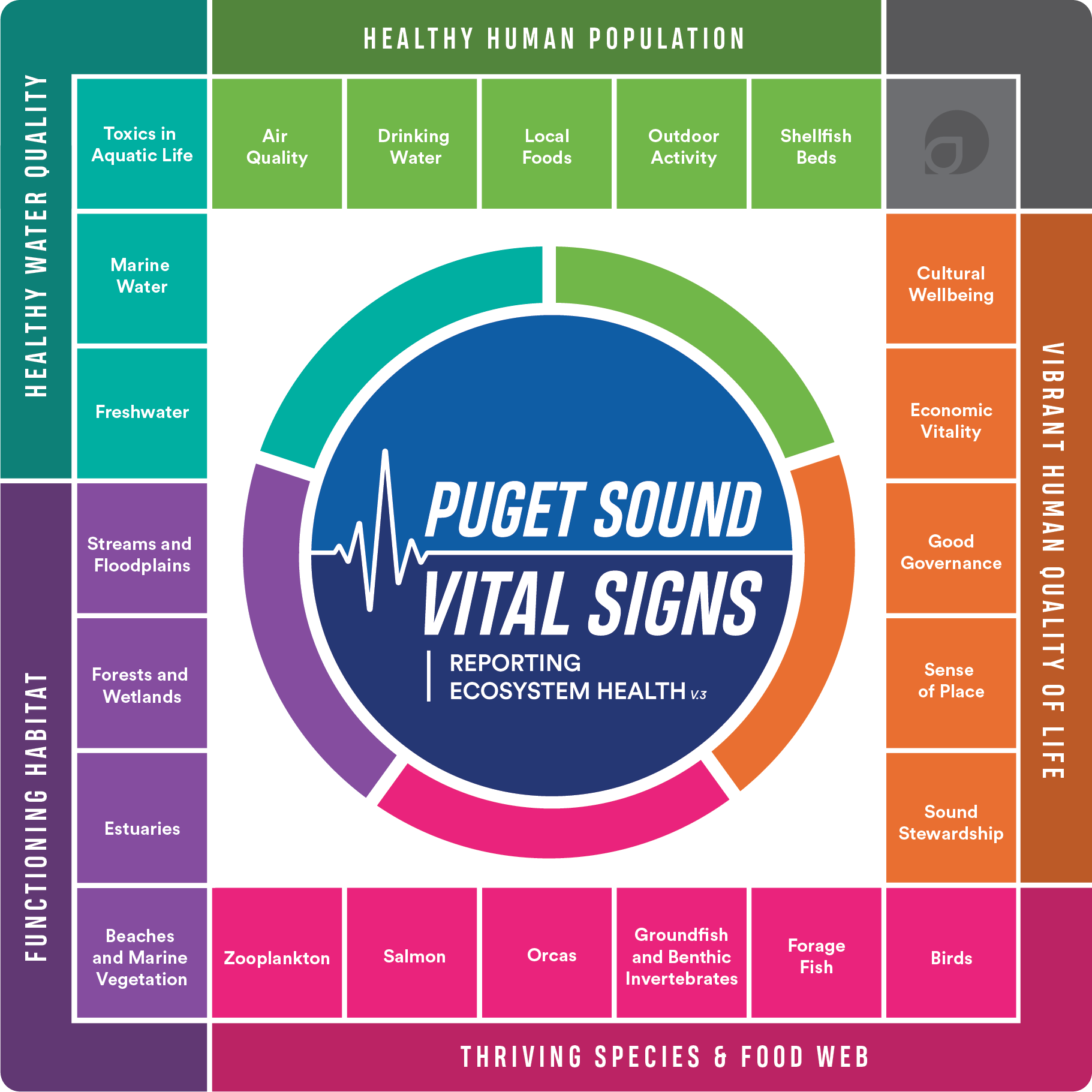
We can think of the Puget Sound Action Agenda (the master plan!) as a list of prioritized strategies within the broader topical goals that aim at achieving ecosystem targets.
The Vital Signs related to kelp and eelgrass management are:
While the Puget Sound Action Agenda is the list of prioritized strategies, the Implementation Strategies are the plans for how to make a strategy a reality (aka how to Implement … the Strategy).
The plans are each called an Implementation Strategy, and
The Implementation Strategy for management of marine vegetation is the Marine Vegetation Implementation Strategy.
These 5 broad topical goals (and their underlying Implementation Strategies) mostly fit into one of three Strategic Initiatives, called the Strategic Initiative Leads.
The three Strategic Initiative Leads are:
- Stormwater
- Habitat
- Shellfish
5.2 Habitat Strategic Initiative Lead (HSIL)
The Habitat Strategic Initiative Lead’s role is to put in place strategies that improve the restoration and protection of the rivers, forests, shorelines, estuaries, kelp, and eelgrass meadows that make up Puget Sound.
5.3 Marine Vegetation Implementation Strategy
5.3.1 Kelp and Eelgrass risk assessments
The Distribution of current and future cumulative risk and contribution of threats to eelgrass and canopy kelp in Puget Sound is a project funded by Puget Sound Partnership through HSIL that resulted in separate arcgis online map tools that display risk levels for kelp and for eelgrass.
6 Washington Department of Natural Resources (DNR)
All bodies of saltwater in Puget Sound are Washington State inland (estuary) waters. Under the Submerged Lands Act and Article XVII of the Washington State Constitution, the state owns and manages the bedlands, tidelands, shorelands, and waters of all its navigable inland waterways.
DNR manages state aquatic lands including marine bedlands and aquatic reserves, as well as kelp protection, monitoring, and restoration programs. DNR approval and permits are required for commercial kelp or seaweed harvest and sale, including from private tidelands.
The Washington State Legislature RCW 79.135.410 sets the maximum daily wet weight harvest for personal use limit to 10lbs per licensee, prohibits commercial harvest of seaweed (a distinct rule from commercial seaweed aquaculture rules), but does allow commercial harvest and import of Macrocystis for the herring spawn-on-kelp fishery. The rule indicates that WA DNR and WDFW can coordinate if they feel the need to lower the personal use limit for conservation.
7 Washington Dept. of Fish & Wildlife (WDFW)
The Washington Department of Fish & Wildlife sets the personal use seaweed harvest rules for seaweed in the state that are subject to be updated. The blanket rules for seaweed harvest in Washington are:
If 16 years or older, you must have a Shellfish/Seaweed License
Daily limit of 10lbs wet weight per licensee
It is illegal to harvest seaweed if herring eggs are attached
All State Park beaches are closed to seaweed harvest except from April 16 - May 15 at Fort Flagler, Fort Ebey, and Fort Worden State Parks.
Seaweed harvesting in State Parks is limited to posted park hours and special State Park rules below:
Bull kelp must be cut a minimum of 24” above the bulb and short stemmed kelps must be cut a minimum of 12” above the anchor point. The anchor point must be left in place at all times.
Only a knife or similar instrument may be used to harvest seaweed. Tearing the plant and use of tined instruments such as rakes or forks is prohibited.
Each harvester must use their own container. Multiple limits may not be combined in the same container.
Each harvester must use a scale to determine when the harvest limit has been reached. Drying or partial drying prior to weighing is prohibited.
Dr. David Trimbach is hosting Kelp Community Workshops (May-Nov 2026) as part of a research project entitled “Enhancing Kelp Protection and Restoration through Community-Based Social Science Research,” funded by the Habitat Strategic Initiative Lead.
More information is available in the Shellfish/Species rules and on WDFW’s Fishing license types and fees webpage.
Seaweed harvesters should also review the Washington State Department of Health shellfish safety map for biotoxin- or pollution-related closures and advisories. Water quality conditions change quickly; check the map the day you plan to harvest.
https://wdfw.wa.gov/species-habitats/ecosystems/marine-shorelines/kelp#how-participate
8 Northwest Straights
9 Notes on Cooperation with Canada
9.1 Joint Statement of Cooperation
In 2000, the EPA and Environment and Climate Change Canada signed a Joint Statement of Cooperation that commits to work collaboratively to achieve common goals. This agreement calls for the two agencies to develop and periodically update a Salish Sea Action Plan, often titled Canada - U.S. Cooperation in the Salish Sea Action Plan. This plan focuses on areas where U.S. and Canada can coordinate protections and restoration priorities. It is collaboratively written by a coalition of advisory members.
Current advisory members represent the following organizations:
Coast Salish Gathering Steering Committee
British Columbia Ministry of Water, Land and Resource Stewardship
British Columbia Ministry of Environment and Parks
Washington State Department of Ecology
Puget Sound Partnership
Northwest Straits Commission
Salish Sea Institute at Western Washington University
9.2 Health of the Salish Sea Ecosystem Report
Written by the U.S. EPA and Environment and Climate Change Canada.